

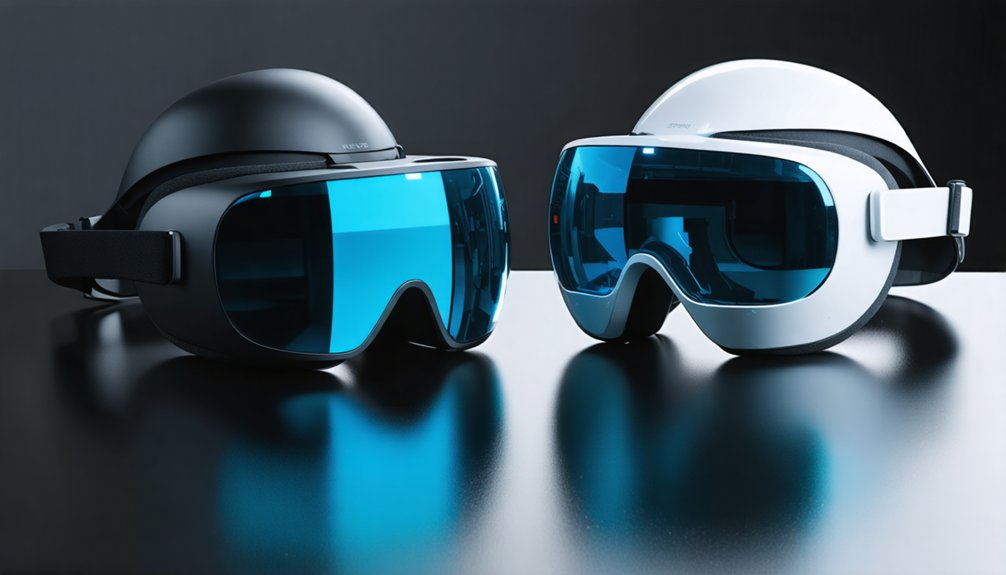

Augmented reality headsets now combine high‑resolution OLED or micro‑LED panels, pancake optics, increased per‑eye pixel counts and lighter form factors for extended wear. Vendors add on‑device AI, advanced neural engines, integrated eye and hand tracking, and varifocal or depth‑aware rendering for realistic focus. Standalone SoCs, split‑rendering and cloud graphics reduce tethering. Enterprise models emphasize durability, security, and workflow integrations. New platforms and SDKs expand developer tools, enabling broader consumer and professional use — continue to explore specifics and roadmaps.
Key Takeaways
- New high-performance chips (e.g., Apple M5) enable on-device AI for eye-tracking, gesture recognition, and real-time spatial scene generation.
- Pancake optics and micro-OLEDs are shrinking headsets while boosting contrast, resolution, and edge-to-edge clarity.
- Varifocal displays, continuous IPD, and OpenXR depth improve focus realism and reduce visual fatigue.
- Standalone designs with modular compute and 5G/cloud split-rendering shift gaming and enterprise away from PC tethering.
- Product roadmaps target professional workflows, lighter wearability, and lower-cost consumer variants to expand mainstream adoption.
Apple’s Vision Platform: M5 Revision and Affordable Headset Plans
Often positioned as a professional-grade upgrade, Apple’s M5-powered Vision Pro refresh consolidates major hardware and software advances—up to 12 CPU cores, a 12‑core GPU with hardware ray tracing, a 16‑core Neural Engine, and up to 64GB unified memory—built on TSMC’s 3nm N3P node to deliver 15–20% faster CPU performance, ~15% GPU gains, improved thermal efficiency, and substantially better AI capabilities for eye‑tracking, gesture recognition, and spatial scene generation in visionOS 26. The M5 implications are clear: enhanced Neural Engine throughput and expanded memory enable richer AI-driven workflows for professionals in design, medicine, and enterprise. With mass production slated in 3Q 2025 and pricing near $3,500, Apple also signals intent to explore an Affordable headset variant later in its XR roadmap to broaden community access and ecosystem growth. Analysts predict a broader XR strategy including lower-cost headsets and glasses to drive mainstream adoption, highlighting dual-product strategy. In particular, the chip’s on-device AI focus and energy-efficient design point to significant benefits for low-latency AR experiences and reduced cloud dependency, emphasizing on-device AI. The update also reflects a clear focus on comfort & wearability to support longer, multi-hour professional sessions.
Meta’s Expansion: From Ray-Ban Displays to High‑Resolution Quest Devices
While Apple pursues a high‑end Vision Pro refresh and a lower‑cost headset roadmap, Meta has continued to expand its XR footprint by advancing display and optics in its Quest lineup and extending mixed‑reality features from recent Ray‑Ban wearable displays to mainstream headsets.
Meta leverages the Ray Ban legacy to normalize everyday MR interactions while scaling performance: Quest 3 introduces 2064×2208p per eye, 1218 PPI, 25 PPD, and Snapdragon XR2 Gen 2 firsts.
Pancake optics—custom 2x element lenses—enable a 40% thinner enclosure and edge‑to‑edge clarity.
Quest 3 weighs 515 g and Quest 3S offers a budget path with fresnel lenses and retained 1832×1920 resolution.
Continuous IPD, 72/90/120Hz refresh, advanced passthrough cameras, and cloud gaming integration reinforce community adoption and ecosystem strength.
Meta also ships a headset that targets beginners with an entry-level price. Additionally, the Quest 3 delivers improved visual fidelity and reduced artifacts thanks to its pancake lenses.
Valve’s Move to Standalone Gaming Headsets
Valve is shifting the Index line from PC-tethered high‑end hardware toward a standalone gaming headset strategy that combines a custom Qualcomm‑class SoC, Steam Deck split‑rendering, and modular connectivity to remove cable dependence while preserving SteamVR compatibility.
The move repositions Valve from premium, cable‑bound Index hardware toward a flexible ecosystem featuring swappable headstraps for WiGig wireless modules and enhanced compute units.
Micro OLED panels and rotated displays aim for 2k–4k per eye and wider FOV, while varifocal adoption with OpenXR depth support targets realistic focus rendering. Future US is the owner. As of January 2025, Valve Index sets represent 13.2% of Steam-connected VR units.
Backward compatibility, improved controllers, and integrated Qualcomm processing promise standalone performance without abandoning room‑scale SteamVR tracking.
The strategy emphasizes community continuity, modular upgrades, and clearer upgrade paths for committed players. Additionally, the design incorporates dual 1440×1600 RGB LCDs to improve sharpness and reduce screen‑door effects.
Enterprise AR Hardware: Microsoft, Vuzix, and Industry Targeting
Enterprise AR hardware is coalescing around purpose-built headsets and software stacks that prioritize durability, security, and workflow integration for industries from aerospace to healthcare.
Microsoft’s HoloLens 2 exemplifies this with world-anchoring, hand and eye tracking, voice commands, large FOV optics, and a custom HPU delivering over 1 TOP of programmable compute. Windows 11 will be offered as a free upgrade in H1, Despite production ending in October 2024 and strategic shifts away from mixed reality hardware, Microsoft guarantees support through December 31, 2027, stabilizing enterprise adoption and clarifying hardware lifecycle expectations.
Vuzix and other vendors target specific verticals with lighter, role-focused devices.
Use cases in automotive service, aerospace, and healthcare reinforce the value proposition: improved compliance, remote collaboration, and frontline empowerment via integrated software like Dynamics 365 and Windows Holographic updates.
Consumer AR Glasses: New Players and Mainstream Options
In the consumer wearables market, AR glasses are moving from early experiments to mainstream contenders as major players and nimble entrants alike compete on optics, AI, and form factor. Market leaders—Meta with 2 million units and Ray‑Ban growth, XREAL’s global reach, Huawei’s 6% share, plus Amazon and EssilorLuxottica—anchor a vibrant ecosystem where fashion tech convergence matters as much as specs.
Emerging regional entrants and niche brands expand choice and cultural fit, while Google, Samsung, and Qualcomm enable an Android XR platform that broadens hardware diversity. Sales and shipment forecasts, strong audio‑glass adoption, and integrated AI point to accelerating consumer uptake through 2027–2030, reinforcing community around interoperable, stylish devices that balance privacy, utility, and identity.
Display and Optics: 8K Per‑Eye and OLED Microdisplay Trends
As consumer AR glasses push toward mainstream adoption, display and optics advancements are becoming the defining technical battleground — with 8K per‑eye resolutions and OLED microdisplays reshaping expectations for clarity, color, and form factor. The industry trajectory emphasizes 8K-class targets—MeganeX Superlight’s 3,552×3,840 per eye and roadmap claims of 4,096×4,096 render targets—delivering text clarity and fine detail beyond current 2K norms.
OLED microdisplay integration enables lightweight designs (~179–185 g) with 10‑bit microdisplay HDR, 95% DCI‑P3 and superior contrast versus LCDs, though cost confines early adopters. Pancake optics drive thin, low‑distortion profiles and support adjustable IPD and prescription add‑ons.
Implementation trends favor PC‑powered headsets with DSC, 90Hz baseline refresh, SteamVR/OpenXR compatibility and premium tracking for shared, personalized user experiences.
Spatial Computing and AI Integration for Everyday Use
Spatial computing, propelled by rapid AI integration and multimodal sensing, is shifting from niche proof‑of‑concepts to everyday workflows across industry, education, and healthcare. The convergence of LLMs, generative AI, and sensor fusion yields contextual assistants that recognize objects, map 3D spaces, and surface actionable insights in real time. Enterprises deploy these capabilities for training, digital twins, and collaborative design, emphasizing vertical expertise and platform integration over raw hardware specs.
Education and healthcare adopt immersive models to improve comprehension and clinical simulation. Market forecasts and competitive dynamics signal rapid expansion, driving interoperable ecosystems across devices and IoT. Practitioners and organizations seeking community and shared standards benefit from reproducible workflows that scale spatial computing from pilot projects to operational routines.
Design and Usability: Lightweight Builds, Controllers, and Workflow Tools
Building on the shift from experimental spatial computing to operational workflows, hardware and interaction design determine whether AR moves from occasional utility to daily wearables.
Design now prioritizes lightweight builds using ergonomic materials to minimize fatigue and signal belonging to professional and social cohorts.
Controllers evolve from physical wands to hand tracking, gesture and voice control, and passthrough interaction that preserve real-world awareness.
Workflow tools increasingly align with established SDKs—visionOS, SwiftUI, RealityKit, ARKit—and emerging Android XR and web-based, no-code options that reduce friction for teams.
Battery optimization and multi-sensor integration enable longer sessions and reliable split-rendering over 5G.
Together these advances create a credible, inclusive platform for routine AR tasks across retail, enterprise, and creative communities.
References
- https://yordstudio.com/best-xr-headsets-of-2025/
- https://mixed-news.com/en/new-vr-headsets-2025/
- https://artlabs.ai/blog/top-augmented-reality-headsets-enhanced
- https://www.echo3d.com/post/the-best-augmented-reality-glasses-in-2025
- https://www.youtube.com/watch?v=KzSmM7ANYgQ
- https://vr-compare.com
- https://virtual.reality.news/news/apple-vision-pro-2025-m5-chip-7-new-xr-projects-revealed/
- https://www.jonpeddie.com/news/apples-a19-and-upcoming-m5-chips/
- https://www.webpronews.com/apple-vision-pro-roadmap-2025-m5-refresh-2026-pro-2-2027-vision-air/
- https://www.youtube.com/watch?v=aUWJqhz4NKQ&vl=en