

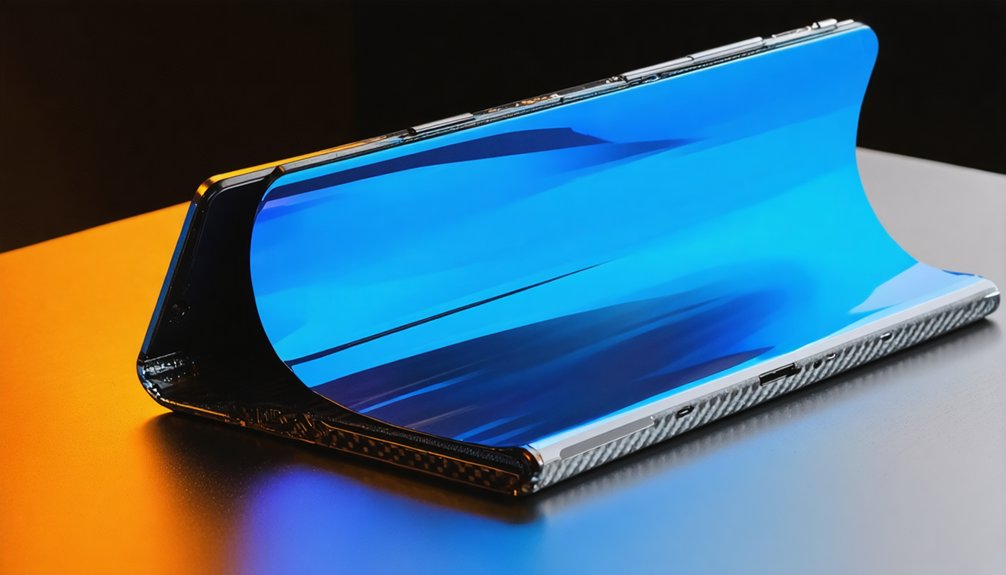

Next‑gen foldables deliver thinner, stronger hinges and lighter aerospace‑grade frames for far improved durability and fewer visible creases. Batteries grow denser with silicon‑carbon chemistry and larger cells while thermal designs and faster wired and magnetic wireless charging maintain sustained performance. Cameras and on‑device AI enable pro‑level imaging and real‑time editing on the device. Software adapts to multiple screen states for true laptop‑class multitasking. The summary highlights concrete hardware, battery, camera and software advances; more specifics follow.
Key Takeaways
- Thinner, stronger hinges enabling thousands of fold cycles and flatter, crease‑reduced screens with improved structural stability.
- Lighter, premium materials and UTG 3.0 glass for sub‑250g devices with better scratch, impact, and water resistance.
- Bigger batteries and efficient 3nm SoCs delivering roughly 20% real‑world runtime gains and fast wired/wireless charging.
- Advanced camera systems and on‑device AI for pro‑grade imaging, real‑time editing, and adaptive multi‑screen workflows.
- Faster mainstream adoption with lower prices, carrier financing, and expanded enterprise support driving wider availability by 2027.
Breakthroughs in Foldable Hardware and Performance
Several measurable hardware and performance advances have converged to redefine modern foldable devices. Engineering gains, including a third-generation Armor FlexHinge with a 27% thickness reduction and gearless micro hinge architectures, reduce bulk while maintaining folding integrity. New alloy components raise yield strength over 14%, and separated support and rotation functions improve structural stability and wingplate designs that yield flatter screens. Power and thermal management coalesce: ultra-high-density circuit boards liberate internal space for larger batteries (up to 5,015 mAh) while optimized heat dissipation keeps sustained performance. Leading chipsets — Snapdragon 8 Elite and Tensor G5 — enable stronger on-device AI and efficient multitasking across dual screens. Together these measured advances deliver more durable, powerful, and community-minded foldables, and the market’s current best overall pick, the Samsung Galaxy Z Fold 7, exemplifies these improvements. Manufacturers are also emphasizing longer software support to ensure devices remain secure and feature-rich over several years.
Thinner, Lighter, and More Durable Designs
Built from aerospace-grade alloys, carbon-fiber supports, and refined hinge architectures, the latest foldables achieve markedly thinner, lighter, and more durable profiles without compromising functionality. Manufacturers leverage material innovations—polished aluminum, matte glass, silicon-carbon components, and advanced silicon anodes—to shave weight while preserving structural integrity. Hinge miniaturization and new mechanisms, including water-drop and Zero-Gap designs, boost folding cycles from 200,000 to 500,000 and enable seamless closure and smoother operation. IPX8-level sealing, improved glass chemistry, and enhanced surface strength reduce environmental vulnerability and crease visibility, supporting longevity. Devices like the Galaxy Z Fold7 and OnePlus Open exemplify these strides, offering sub-240g or category-leading thinness. The result is a family of foldables that feel premium, reliable, and belongingly accessible, with many models now shipping with UTG 3.0 for better scratch and impact resistance. Manufacturers are also expanding their portfolios to include two new smartwatches and refreshed foldable lineups announced for 2025.
Battery Life and Charging Improvements
Although foldable form factors once forced compromises in battery capacity and charging, recent generations close that gap through larger cells, smarter chemistry, and improved power delivery.
Manufacturers now pack batteries comparable to flagships—4,500–5,015 mAh in modern models—enabled by silicon‑carbon battery chemistry and refined thermal design. Future US Inc is an international media group and leading digital publisher. Silicon‑carbon cells boost capacity ~10–15% over standard Li‑ion.
Power efficiency improvements from 3nm chipsets, OLED panels, and optimized SoCs extend real‑world runtimes; conservative testing shows ~20% gains, with some devices reaching two‑day use or more.
Charging ecosystems also mature: faster wired speeds preserve charging time despite larger cells, while Qi2 magnetic and improved wireless charging implementations resolve alignment and heat issues.
Together, these advances make foldables viable daily drivers for communities seeking both innovation and dependable endurance.
Camera Systems Tailored for Foldable Form Factors
Battery and charging improvements have given foldables the runtime to support more demanding camera hardware and sustained imaging workflows, allowing manufacturers to prioritize larger sensors and richer feature sets without sacrificing everyday usability.
Foldable specific optics and hinge mounted stabilization enable unique configurations: flagship sensors like 200MP modules and multi-camera arrays (50MP main plus 50MP telephoto and 8MP ultrawide) fit ultra-thin bodies while maintaining portability.
Benchmarks now show foldables reaching top camera scores, aided by ProVisual engines and Tensor-class processors for real-time adjustments and advanced post-processing. Camera technology continues to be a leading differentiator driving rapid innovation.
Form-factor features—Flex Cam framing, dual-screen viewfinders, self-standing shooting, and expanded editing displays—support creators with professional 8K recording, pro interfaces, improved low-light performance, consistent multi-lens exposure, and smoother zoom control. AI-driven image engines also enable on-device scene optimization and real-time adjustments to lighting and motion, powered by aerospace‑grade hinge alloys.
On‑Device AI and Smarter Software Experiences
How do foldable phones turn expansive, flexible displays into truly intelligent tools? Manufacturers embed potent on‑device AI—Pixel 10 Pro Fold’s Tensor G5, Snapdragon 8 Elite, and HONOR Magic V5—to run features locally, preserving on‑device privacy while enabling real‑time tasks like call translation and image-to-video generation. Platforms pair hardware with adaptive interfaces: One UI 8 and Pixel Instant View dynamically reconfigure layouts, widgets, and app placement for cover and main screens. Tailored controls let users choose on‑device or cloud processing; Knox Matrix Trust Chain and device-level protections govern data flow across ecosystems. AI photo tools, Add Me and Camera Coach, plus side‑by‑side previews, demonstrate evidence-based enhancement rather than gimmickry, fostering user trust and a sense of shared participation. The next foldables push this further with “Ultra Unfolds” design cues that highlight expansive inside and outside screens. Manufacturers are also advertising improved durability through new hinges and reinforced displays to support prolonged everyday use.
Enhanced Multitasking and Productivity Features
Building on on‑device intelligence that reconfigures interfaces and prioritizes privacy, foldable phones now pair adaptive software with hardware to make multitasking genuinely productive.
The expanded displays and redesigned taskbars enable true multi‑app workflows—Split Trio and Multi‑Flex modes keep three apps active, arranged vertically or horizontally, while tri‑fold screens create tablet‑level workspace.
Hardware like Snapdragon 8 Elite chips, up to 16GB RAM and large batteries sustain sustained switching and background processing.
Professional tasks benefit from timeline editing, side‑by‑side photo comparisons, stylus annotation and handwriting recognition that span folding states.
Software refinements—Samsung DeX, OnePlus Open Canvas, contextual toolbars and a cross app clipboard—streamline drag‑and‑drop, clipboard sharing and app mirroring, making the devices collaborative, reliable tools for community‑minded professionals.
Market Trends, Availability, and Pricing
Several indicators point to a rapid maturation of the foldable smartphone market: global shipments climbed to 17.2 million units in 2024 and the sector is projected to grow from an estimated USD 31.3 billion in 2025 to roughly USD 118.9 billion by 2030, reflecting a compound annual growth rate near 30.6%.
Market momentum is driven by material advances, carrier subsidies, and falling component costs that allow OEMs to introduce Fan-Edition lines below USD 1,000.
Regional adoption concentrates in Asia Pacific, where integrated supply chains and strong domestic demand shape global availability and pricing.
Enterprise interest, steady refresh cycles, and software optimization bolster commercial uptake.
Emerging subscription models and carrier financing broaden access, signaling mainstream penetration around 2027.
What Comes After Dual‑Screen Foldables
In exploring what follows dual‑screen foldables, the industry is pivoting toward tri‑fold and multi‑fold architectures that expand usable surface area without sacrificing pocketability.
Manufacturers, led by Samsung’s Galaxy G Fold roadmap, prioritize tri fold interfaces that turn phones into tablets and larger displays while retaining portability.
Modular hinges and titanium‑reinforced mechanisms address earlier durability and ingress concerns, matching IPX9 and thousands‑cycle longevity targets.
Display and SoC advances—8‑inch internal panels, Snapdragon 8 Elite variants, and custom thermal profiles—ensure seamless shifts across folded states.
Rollable concepts and configurable modular designs signal pathways beyond fixed dual screens, with stylus support and robust batteries supporting new workflows.
The shift feels collaborative and inclusive, inviting users to adopt multi‑fold formats as practical, reliable tools.
References
- https://www.phonearena.com/news/best-foldable-smartphones_id132093
- https://www.stuff.tv/features/best-foldable-phones/
- https://www.tomsguide.com/best-picks/best-foldable-phones
- https://www.youtube.com/watch?v=XsL1F2YmpRg
- https://www.androidcentral.com/best-foldable-phone
- https://www.youtube.com/watch?v=Rc8QxekjrAw
- https://vocal.media/futurism/foldable-phones-in-2025-revolutionizing-mobile-tech-and-regenerating-the-future
- https://www.lightreading.com/smartphones-devices/foldable-smartphone-market-rebounds-report
- https://omdia.tech.informa.com/blogs/2025/sep/foldable-smartphones-are-moving-into-a-pivotal-2026
- https://news.samsung.com/us/the-breakthroughs-powering-samsungs-thinnest-most-refined-foldables/