

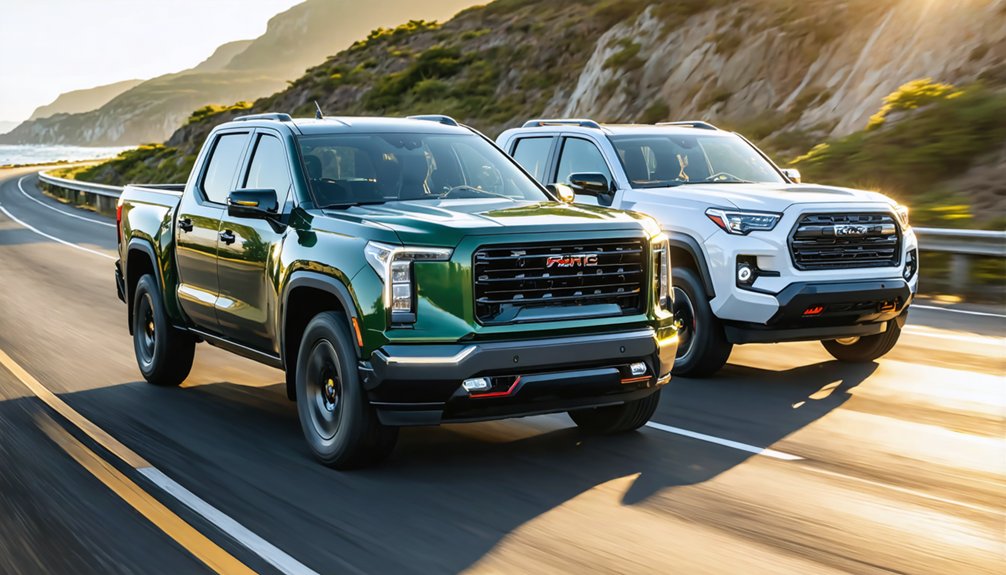

The next wave of EV trucks will arrive later and leaner than initial promises, with many flagship launches pushed back as automakers prioritize profitability and production efficiency. Expect dedicated, scalable platforms that cut parts and wiring, improve packaging, and enable clear price tiers. Real‑world range and towing will be transparent, with trade‑offs between payload and efficiency. Charging networks, megawatt standards, and bidirectional options will boost commercial uptake. Further sections explain platform, charging and performance details.
Key Takeaways
- More realistic launch timetables and delayed rollouts as manufacturers recalibrate costs and prioritize profitable, smaller models.
- Improved platform efficiencies cut parts, weight and wiring, lowering costs and improving interior space and durability.
- Real‑world ranges and towing will vary widely by trim, with efficiency‑focused models reaching 300–500+ miles under optimal conditions.
- Charging networks expand with high‑power and megawatt hubs, but session reliability and site availability will still vary regionally.
- Growing commercial adoption and bidirectional use cases unlock fleet savings, grid services and new revenue streams for truck owners.
The Changing Timeline: Delays and New Launch Dates
Why are electric truck launch dates slipping across the industry? Industry players cite revised production timelines driven by financial pressure, quality setbacks, and shifting demand forecasting.
Ford’s Project T3 moved repeatedly from 2025 to 2028, while E-Transit and other models faced similar two- to three-year postponements; Nissan likewise delayed 2028 SUV launches. Companies are reallocating plants, abandoning some EV plans, and prioritizing smaller, lower-cost models to align unit economics with customer demand.
Loss projections, costly recalls, and the need to integrate cheaper battery technology justify slower rollouts. Ford’s EV unit is projecting a $5.5 billion loss in 2025, reflecting the broader financial strain on ambitious EV timelines. Slate Automotive’s budget truck targets deliveries in Q4 2026, highlighting a range of strategies from no-frills entrants to delayed flagship programs.
The result is an industry-wide recalibration: manufacturers temper ambitious schedules, repurpose facilities, and adjust forecasts to maintain community trust and sustainable growth rather than pursue premature volume launches. Recent company moves include Nissan delaying two SUVs at its Canton, Mississippi plant to refine production timing and value delivery.
Platform Innovations Built for Electric Trucks
Against the backdrop of delayed rollouts and tightened unit economics, platform engineering has become the decisive battleground for electric trucks, with manufacturers pursuing integrated architectures that cut parts and complexity, lower costs, and improve durability and interior packaging.
OEMs emphasize battery architecture and structural integration to achieve these aims: Ford’s universal EV platform trims parts by 20% with 25% fewer fasteners and shorter wiring harnesses, while using LFP prismatic cells and a structural battery pack as the vehicle floor. LFP prismatic batteries are cobalt-free and nickel-free and act as a structural sub-assembly serving as the vehicle floor, improving handling and cabin quietness. Rivian’s skateboard concentrates components low for durability and cabin space. GM’s Ultium modular approach balances flexibility and higher energy density across segments and integrates advanced electrical architectures. Volkswagen Group’s MEB platform supports a wide range of vehicle sizes and drive configurations, reinforcing the industry’s push for scalable, shared architectures.
Collectively, these innovations reduce assembly steps, weight, and total cost of ownership. [Platform reduces parts by 20%
Range, Towing and Real-World Performance Expectations
Frequently, buyers judge electric trucks by two practical metrics — range and towing — that together determine real-world utility more than headline battery capacity.
Evidence shows consumer models varying from roughly 325–539 miles and commercial units up to about 373 miles, driven by battery chemistry, pack size and vehicle weight.
Independent tests (60/40 city/highway at ~40 mph, 64°F) produced results like 507 miles for a GMC Denali Max Range and a Silverado exceeding EPA by 47 miles.
Towing figures span 8,400–14,000 pounds with payloads up to 3,500 pounds; tri-motor and high-torque layouts boost capability but reduce range.
Manufacturers emphasize payload optimization and lighter configurations to preserve efficiency.
Transparent comparisons, real-world testing and clear specs help buyers assess suitability.
The commercial market is also shifting quickly, with EU BEV truck registrations rising 51.6% in H1 2024 — a sign of growing industry adoption and infrastructure development.
Battery longevity and charge standards also shape ownership cost and usability, especially as tests show different outcomes under EPA testing.
GMC’s Sierra EV highlights the trend with its 205 kWh battery pack and 800V architecture.
Charging Networks, Standards, and Bidirectional Power
Anchored by advancing megawatt charging standards and expanding public–private investments, the charging ecosystem for electric trucks is moving from experimental pilot projects toward commercially viable, high-throughput networks.
Ongoing projects—like a $75 million San Bernardino hub slated to serve 200+ Class 8 trucks daily with 10 MW grid draw—illustrate scale.
NREL’s Megawatt Charging System work targets 3.75 MW delivery and megawatt interoperability so diverse equipment and vehicles couple reliably.
Network uptime approaches 99%, yet session success gaps highlight operational work ahead; hardware evaluations and troubleshooting feedback are closing those gaps.
Concurrently, bidirectional economics and V2G pilots frame trucks as mobile storage assets, enabling revenue streams for owners, grid services for utilities, and increased system resilience through coordinated integration.
EV Realty is developing large-scale hubs and plans additional projects, including a joint venture targeting $200 million in charging hub projects overall. A key driver is falling battery prices that are helping fleets commit to large-scale electrification.
Aerodynamics, Efficiency and Energy-Saving Tech
Building on advances in vehicle architecture and component integration, electric truck designs now emphasize aerodynamic precision and systemic efficiency to extend range and lower operating costs.
Designers deploy cab stabilizers—small oblique vanes at windshield corners—camera monitor systems replacing mirrors, and active deployable elements to control airflow attachment and reduce drag.
Dedicated EV platforms cut parts, fasteners and wiring, enabling lighter assemblies that complement low-center-of-gravity battery placement.
Structural batteries serve dual roles as floor and energy storage, lowering mass and improving packaging while supporting ranges up to 420 miles in optimized tractors.
Proprietary e-axles, LFP prismatic chemistry, instant torque delivery and software-updatable controls create measurable efficiency gains.
Transparent metrics and shared standards foster community trust among fleet operators and drivers.
On-Road Handling, Off-Road Capability and Ride Quality
With a substantially lower center of gravity and instant electric torque, modern EV trucks deliver markedly different on‑road dynamics and off‑road capabilities than their internal‑combustion counterparts. Evidence shows floor‑mounted battery packs yield superior weight distribution, producing predictable steering response, reduced body motion and low roll in cornering and lane changes.
Instant torque provides immediate acceleration for highway merging, towing starts and technical off‑road maneuvers without gearbox lag. Regenerative braking and advanced control systems enhance deceleration stability and recover energy in stop‑and‑go or hilly conditions, improving range in everyday use.
Quad‑motor and torque‑vectoring architectures further enable individual‑wheel traction control for rock crawling and steep grades. Riders benefit from smoother power delivery and confidence-inspiring stability across paved and rugged terrain, supporting shared ownership experiences.
Pricing, Trim Levels and Market Positioning
Ride and capability advantages shape buyer priorities, but final purchase decisions hinge on pricing tiers and how manufacturers package range, towing and features across trims.
OEMs deploy clear price tiers: Ford targets entry affordability with the F-150 Lightning at $51,975, while GM, Rivian and Tesla cluster $70k–$75k mid-range offerings.
Trim differentiation defines value positioning — Chevrolet’s LT adds performance and optional Premium Package, Ford offers battery choices and Flash mid-spec, Rivian and Tesla vary motor counts.
Badge strategy separates work, mid and luxury segments: F-150 dominates work trucks, GMC Denali and Hummer occupy $90k+ luxury, Sierra EV Max Range sells efficiency, Silverado EV emphasizes horsepower.
Transparent packaging will decide perceived fairness and mainstream adoption.
Sales Trends, Demand Shifts and What Comes Next
Across the first half of 2025, electric pickup momentum slowed: most manufacturers reported declining sales while General Motors alone posted gains, and Rivian’s deliveries fell from over 27,000 to 19,311 year‑over‑year.
Market data show a mixed picture: global electric truck sales had surged in 2024, but U.S. EV share slipped to 7.4% in Q2 2025 as volumes eased to 310,839.
Chevrolet Silverado EV and GMC Sierra EV posted modest totals; Rivian and legacy brands jockey for share while Tesla still holds significant market control.
Demand patterns were heavily influenced by consumer incentives and purchase timing tied to federal tax credit changes, creating a near‑term Q3 spike and longer‑term uncertainty as automakers adjust production and pricing strategies.
References
- https://topelectricsuv.com/featured/upcoming-electric-pickup-trucks-release-2021/
- https://www.capitalone.com/cars/learn/finding-the-right-car/every-electric-truck-coming-by-2026/2924
- https://www.ford.com/trucks/f150-lightning/
- https://www.rivianforums.com/2025-rivian-r1t-is-the-edmunds-top-rated-electric-truck-2025/
- https://www.youtube.com/watch?v=rGMr4jSOZb4
- https://rivian.com
- https://ev.com/news/ford-delays-ev-launches-affordable-models
- https://www.electrive.com/2025/08/08/ford-delays-launch-of-electric-pickup-shifting-focus-to-cheaper-evs/
- https://www.wardsauto.com/news/archive-auto-nissan-delay-ev-production-caton-mississippi/752652/
- https://americancarsandracing.com/2025/08/08/fords-electric-pickup-delayed/