

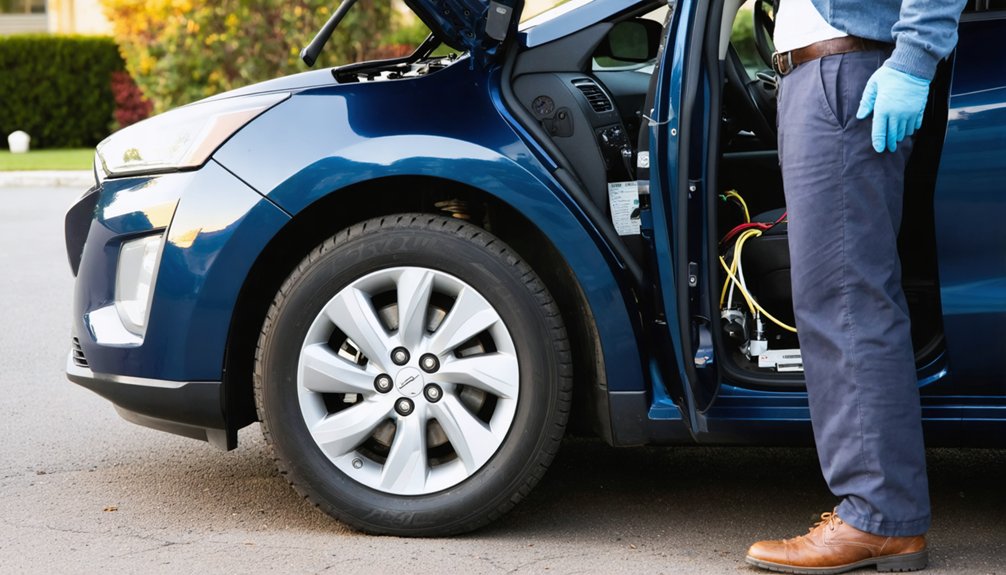

A thorough pre‑purchase check targets the high‑voltage battery, charging system, control modules, and regenerative braking integration. Inspect pack physical condition, cell voltages, coolant and cooling components, and DCDC/DC‑DC converter behavior. Run hybrid‑capable diagnostics for errors, SOC, and software updates. Verify engine, cooling, brakes, and driveability on a controlled test drive. Review service records, battery warranty, title and mileage. Continued guidance explains specific tests, tools, and red flags to watch for.
Key Takeaways
- Verify hybrid battery health and capacity (aim >80%), inspect pack physically, coolant, and warranty/service history.
- Run hybrid‑capable diagnostic scan for error codes, SOC, cell voltages, and control‑module software updates.
- Test regenerative braking and brakeblend integration for smooth deceleration and ABS consistency during a controlled drive.
- Inspect charging port, cables, wiring, connectors, and DCDC converter behavior for corrosion, damage, and proper AC/DC function.
- Check engine, cooling, fluids, and listen for abnormal noises; confirm seamless transitions between electric and gasoline modes.
Inspect the Hybrid Battery and Electrical System
When evaluating a used hybrid, the buyer should begin with a focused inspection of the battery and electrical system, since these components dictate performance, range, and future repair costs.
The inspector verifies charging system functionality, measures charging speed against manufacturer specs, and tests ports, cables, and adapters for damage or fraying.
Attention is paid to wiring integrity and signs of connector corrosion that predict later failures.
The separate electrical cooling circuit is checked for correct coolant type, levels, leaks, and operational efficiency under load.
Diagnostic scans reveal control-module errors, battery efficiency trends, and required software updates.
Dashboard warning history and electric-drive behavior, including regenerative braking and electric-only mode, complete a thorough, community-minded pre-purchase assessment.
Also confirm the vehicle has had recommended software updates and that its system behaves like a modern computer during diagnostics.
Inspectors should also request a full diagnostic scan to check state of charge and capacity degradation.
Hybrid registrations in Australia have surged by 50% over the past year, so buyers should be aware of increased market activity and service demand market trend.
Verify Battery Pack and Cell Health
How can a buyer reliably determine the true condition of a hybrid’s battery pack and cells? A quantitative approach combines OBD-II data, visual inspection, and professional testing.
Use a model-compatible OBD-II scanner or Dr Prius/Dr Hybrid with an OBD Bluetooth reader to read State of Charge, cell voltages, charging cycles and error codes; run full battery and life-expectancy tests. Regular monitoring of fuel economy and performance can also reveal battery issues, since a failing pack often reduces efficiency and drivability direct impact on MPG. Inspect the pack for damage, corrosion, loose high-voltage connections, cooling components and mounting hardware.
Watch for signs of uneven cell voltages that indicate poor cell balancing or progressive voltage drift.
Confirm reported maximum capacity vs. new-spec values (aim for >80% for suitability). When in doubt, obtain manufacturer-approved diagnostics to verify results and document any warranty or service history. Also consider checking OBD trouble codes and load-test results to detect early faults and plan replacement OBD diagnostics. Additionally, scheduling periodic professional inspections helps catch problems early and extend battery life early detection.
Check Charging System and Battery Control Module
After verifying pack and cell health, attention should shift to the vehicle’s charging system and battery control module, since reliable charging and accurate management determine real-world hybrid performance and longevity.
Inspect the charging port and cables for damage, corrosion, secure connections and proper grounding; test engagement mechanisms and verify operation at AC and DC stations.
Run diagnostics on the battery management module to confirm accurate state-of-charge reporting, cell balance monitoring, thermal integration and main relay function.
Verify communication between charging infrastructure and vehicle, including pilot wire signaling, voltage/current sensing and DC/DC converter behavior.
Review control system error logs and make certain infotainment and control modules have current software updates that address recalls or charging optimizations.
Also check the vehicle’s coolant levels and thermal system function to confirm battery SOH and support long-term battery longevity. Additionally, confirm the charging station and vehicle support AC/DC charging compatibility. Be sure to also confirm the vehicle’s remaining warranty status to reduce the risk of costly repairs and protect against major failures, especially the battery warranty.
Examine Engine and Mechanical Components
In evaluating a used hybrid, a focused inspection of engine and mechanical systems is essential to verify reliability and avoid costly repairs.
The buyer should perform an oil inspection—change oil and filter if possible—to assess viscosity, color, sludge, and residue on cap and dipstick as indicators of maintenance history.
Inspect for fluid leaks under the engine bay and parking spots, distinguishing condensation from coolant, oil, fuel, or transmission fluid.
Verify cold idle behavior and listen for abnormal noises or vibrations.
Assess cooling system components: radiator, hoses, reservoir, fan, thermostat and coolant mixture.
Examine brakes, rotors, pedal feel and brake fluid level, and inspect exhaust condition and undercarriage for oily tailpipe residue, heavy rust, or structural damage requiring repair.
Ask who drove the vehicle most to better assess the principal driver.
Evaluate Hybrid-Specific Drive and Regeneration Systems
Why test the hybrid-specific drive and regeneration systems before purchase? Inspectors should verify motor placement and observe torque delivery characteristics during low-speed acceleration and coasting.
Confirm MG1 and other motor generators engage smoothly—silent engine starts, electric-only pull, and seamless assist to the gasoline engine indicate healthy components. Check that the power split device and planetary gearbox transfer rotation cleanly between sources without binding.
Evaluate regenerative function by noting energy return during deceleration and that the inverter and power control unit manage DC/AC conversion and battery charging effectively. Verify the high-voltage battery accepts recovered energy and the DCDC converter supports 12-volt systems.
These checks guarantee integrated drive systems and regeneration contribute to efficiency, reliability, and shared confidence among owners.
Test Braking and Safety Systems
How should braking and safety systems be tested on a used hybrid to verify reliable stopping performance and electrical integration? Inspection should combine component checks and functional trials.
Shift to neutral to isolate mechanical braking, then compare pulsation in drive versus neutral to separate regenerative from rotor issues. Verify smooth pedal modulation and consistent pedal feel across battery charge levels; note any sponginess, vibration, or excessive travel.
Inspect pads, calipers, slides and rotors for uneven wear, corrosion or warping. Validate ABS through controlled stops, warning-light scans and wheel‑speed sensor checks.
Scan hybrid control units for brakeblend calibration faults, motor control communication errors and BMS warnings affecting regeneration. Confirm master warning and instrument indicators operate.
Repeatable, measured inputs should demonstrate dependable integration between friction and electrical braking.
Run Comprehensive Diagnostics and Test Drive
Following the braking and safety checks, attention turns to a full diagnostic sweep and a methodical test drive to confirm electrical integration, battery health and overall drivability.
A pre purchase scanner tailored to hybrids should be used—OBD2 hybrid-capable tools reveal pack efficiency, PCU status, sensor faults and regenerative braking performance that generic scanners miss.
Technicians with hybrid equipment can assess high-voltage pack condition and inspect terminals and cabling for corrosion or damage.
During a controlled test drive, observers evaluate shift smoothness between electric and gasoline modes, cooling response, ABS behavior and regenerative braking feel.
Dashboard lights, unusual load patterns or jerky shifts warrant further diagnostics.
Together, targeted scans and a focused drive create collective confidence before purchase.
Review Service Records and Maintenance History
When evaluating a used hybrid, a thorough review of service records and maintenance history is essential to gauge prior care and anticipate future costs. Service records reveal adherence to manufacturer schedules, frequency of professional hybrid-specific servicing, and whether traction battery maintenance or replacement has occurred. Complete documentation reduces uncertainty about potential repair costs—especially battery and specialized brake work—and suggests responsible ownership.
Missing records or inconsistent entries warrant deeper inquiry through owner interviews and vehicle history reports to uncover undisclosed damage or neglect. Attention to battery warranty status and documented charging habits materially affects valuation.
Prioritize cars with consistent, certified technician service entries; they indicate community-minded owners who respected hybrid requirements and help prospective buyers predict reliability and long-term expenses.
Confirm Title, Mileage, and Emissions Compliance
Making sure clear title, accurate mileage, and emissions compliance is a critical step in evaluating a used hybrid’s legality and value.
The buyer should verify title authenticity via NMVTIS and obtain official documentation or a notarized printout from the previous state’s motor vehicle division; out-of-state titles branded “Rebuilt” transfer that brand.
VIN physical inspection must match documents and remain unaltered to prevent fraud.
Odometer readings should be cross-checked with maintenance records and required verification forms; discrepancies reduce value and signal tampering.
Confirm lien status through title records to avoid unexpected encumbrances.
For plug‑in hybrids, confirm any clean vehicle eligibility details are reported.
Finally, making sure local emissions compliance and required inspections are current to avoid registration or resale issues.
Assess Cabin Comfort Systems and HVAC Operation
After verifying title, mileage, and emissions, attention should shift to cabin comfort systems and HVAC operation, because these systems affect daily usability and can reveal hybrid‑specific issues. Test heating and cooling at idle and while driving to confirm hybrid battery cooling doesn’t compromise climate; note responsiveness when the vehicle shifts between electric and gasoline modes.
Check temperature consistency and ventilation balance across all vents and zones, including defrost performance and recirculation effectiveness. Inspect cabin air filter, evaporator for moisture or odors, and verify pollen/particulate filtration.
Operate heated/ventilated seats, steering wheel heat, power seat adjustments, and seat memory. Verify HVAC controls, sensors, fan noise, moonroof seals, window operation, smartphone climate connectivity, and interior lighting including ambient lighting for complete cabin comfort assessment.
References
- https://greasemonkeyinspectors.ca/hybrid-or-electric-vehicle-inspection-checklist/
- https://www.sftoyota.com/static/brand-toyota/tcuv/160-Point-Inspection-Checklist.pdf
- https://www.gmcertified.com/content/dam/gmcertified/na/us/en/index/buy-boldly/02-pdfs/2020-cpo-quantum-172-inspection-check-list.pdf
- https://www.edmunds.com/car-buying/inspect-that-used-car-before-buying.html
- https://www.gpsvehicleinspections.com.au/blog/hybrid-car-inspection/
- https://www.mymidlandstoyota.com/consult-the-used-car-inspection-guide-before-your-pre-owned-purchase/
- https://www.stevensonhendricktoyota.com/cpo-160
- https://www.columbiachrysler.com/tools-resources/how-to-check-and-verify-the-condition-of-a-used-hybrid-suv
- https://wentworthautomotive.net/auto-maintenance/hybrid-auto-care-and-maintenance-checklist/
- https://www.ontarioautocenter.com/news/electric-car-maintenance-checklist-charging-battery-tires-and-more/