

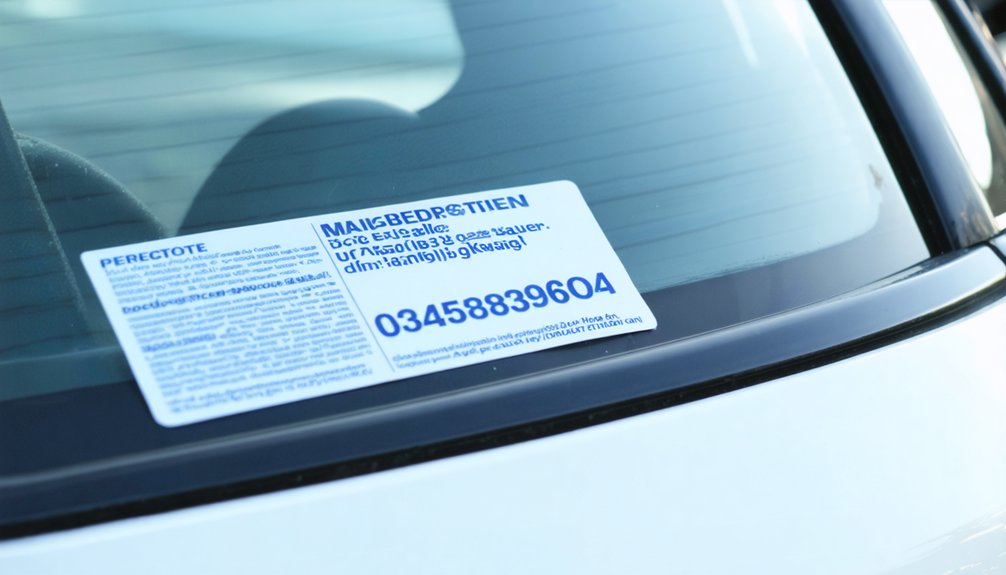

A window sticker summarizes the car’s identity, options, and costs for quick verification. It lists make, model, trim, engine and transmission, and the 17‑character VIN for decoding origin and specs. Paint and upholstery codes, model year, and assembly plant locations appear alongside standard equipment by category. Pricing shows MSRP, destination, and option or dealer add‑ons. Fuel economy, safety ratings, and warranty terms are provided for comparison. Continue for step‑by‑step guidance and deeper checks.
Key Takeaways
- Verify make, model, trim, engine, transmission, VIN and model year to confirm the exact vehicle and production details.
- Check MSRP, destination, and listed optional equipment to understand the pre-tax, dealer‑negotiable price breakdown.
- Review standard safety items and displayed NHTSA/IIHS ratings to compare crash performance and safety features.
- Use EPA fuel economy, MPGe/kWh, and five‑year fuel cost to estimate real-world operating expenses.
- Note warranty, roadside assistance, and corrosion/emissions coverage to compare owner protections and exclusions.
Understanding the Top Corner: Make, Model, Trim, Engine, and Transmission
The top corner of a vehicle window sticker concisely presents the make, model, trim, engine, and transmission so a shopper can identify the car at a glance. Positioned in the top left or right, this standardized section offers immediate visibility and consistent layout across manufacturers. It lists the manufacturer name and model line, model year, and nameplate to aid direct comparisons and reflect brand history that informs perceived value. Trim level is shown clearly—Base, Premium, Limited or coded letters—indicating included feature packages and where feature evolution has altered offerings over time. Engine and transmission specifications, paired together, summarize powerplant, cylinder count, displacement and transmission type to help buyers prioritize performance, economy, and preferred driving setup before deeper inspection. Dealers may sometimes add dealer-added options to the sticker that are not part of the manufacturer’s listed standard equipment. The window sticker also typically shows standard equipment so buyers can quickly see what comes with the vehicle. It’s also helpful to check for optional packages listed separately so you know which features are factory-installed versus added later.
Locating and Decoding the Vehicle Identification Number (VIN)
After noting make, model, trim, engine and transmission on the window sticker, attention commonly shifts to the Vehicle Identification Number (VIN), a 17-character code that uniquely identifies each automobile.
The VIN appears in several standard VIN locations: dashboard near the windshield, driver’s door jamb, stamped on the engine block or firewall, and on older models’ front frame.
Each character conveys specific data: origin, manufacturer, vehicle attributes, a security check digit, model year, and production sequence.
Decoding the VIN reveals assembly plant, safety equipment, engine and weight class, and regulatory compliance.
Shoppers are encouraged to use Decoder tools—manufacturer apps, NHTSA’s decoder, or reputable online checkers—to confirm history, recalls, and authenticity before purchase.
You can typically find the VIN on the dash, door jam, or engine and it is as unique to the car as a thumbprint. An easy way to learn what those positions mean is to use the NHTSA VIN decoder to view the vehicle’s original equipment.
Most vehicles built after 1981 will have a standardized 17-character VIN, which you can use to check assembly country.
Verifying Exterior and Interior Color Codes and Model Year
When inspecting a Monroney label, a buyer should confirm that the exterior and interior color codes and the model year listed in the vehicle identification section match the physical car and other factory labels.
The window sticker’s paint codes (often near make, model, trim, VIN) serve as primary reference for exterior verification; manufacturers use different formats (GM’s WA/8867 variants, Ford’s “EXT PNT,” two‑tone U/L suffixes, BC/CC marks). Buyers should cross‑check door jamb and under‑hood labels and consult paint specialists if codes are unclear. Many manufacturers place color codes on plates, stickers, or stamped locations such as the door jamb, under the hood, or in the trunk, so it’s important to check these spots for the color code.
Interior matching is verified via the standard equipment section, which lists upholstery type and color.
Model year must align with the printed year on the sticker and the vehicle’s production documentation to assure legal and equipment accuracy. Also confirm the sticker’s assembly plant and parts origin details to verify vehicle origin. Manufacturers also include warranty coverage on the sticker so buyers can confirm warranty terms.
Breaking Down the Pricing: MSRP, Destination, and Total Vehicle Price
Having verified paint, interior, and model-year details, attention shifts to the window sticker’s pricing section, where MSRP, destination charges, and optional equipment costs define the vehicle’s advertised value.
The MSRP reflects the manufacturer’s suggested selling price, based on market research and required by federal law on new passenger cars; it excludes taxes, licensing, and dealer charges and serves as a baseline for pricing transparency and negotiation strategies.
Destination is a separate, standardized line item covering factory-to-dealer transport; it varies by manufacturer and vehicle class and is generally non-negotiable.
Optional equipment prices appear as distinct entries so buyers can compare features.
The sticker totals MSRP, destination, and options to show the pre-tax, pre-fee vehicle cost for clear comparison.
New car stickers are legally required in the U.S. and are formally called the Monroney label.
Identifying Optional Equipment, Packages, and Dealer Add-Ons
In examining a window sticker, readers should first locate the optional equipment and additional-installed-equipment sections, which clarify exactly what was factory-installed, bundled in packages, or added by the dealer and how each item affects the vehicle’s advertised price.
The optional equipment area lists factory options individually with prices, revealing how two-tone paint, towing packages, moonroofs, or upgraded audio systems change MSRP.
Package names and trim levels indicate bundled content and total package cost; the same trim can vary widely depending on selected packages.
A separate “Additional Installed Equipment” section flags dealer add ons such as floor mats or cargo covers, often with different warranty terms.
Comparing VIN-matched order records to the sticker guarantees transparency and prevents unauthorized charges.
Reading Standard Equipment by Category: What’s Included
After locating optional and dealer‑installed items on the sticker, readers should next review the manufacturer’s list of standard equipment organized by category to understand what the vehicle includes without add‑ons.
The window sticker breaks standard items into safety and security, exterior, interior and comfort, mechanical and performance, and warranty coverage, reflecting clear feature hierarchies for quick comparison.
Safety listings commonly show airbags, ABS, stability and traction control, backup cameras, and anti‑theft systems.
Exterior entries cover wheels, mirrors, lighting, paint, and trim.
Interior notes detail seating, climate control, audio, lighting, and storage.
Mechanical sections list engine, transmission, suspension, drivetrain, and emissions hardware.
Warranty information specifies bumper‑to‑bumper, powertrain, roadside assistance, corrosion, and emissions terms, highlighting any standard exclusions.
Interpreting Fuel Economy, MPGe, and Environmental Ratings
How much fuel a vehicle uses and the emissions it produces are summarized on the window sticker through a compact set of EPA‑derived metrics—city, highway, and combined MPG for gasoline vehicles, MPGe and kWh/100 miles for electrified models, and an associated five‑year fuel cost and environmental rating—allowing direct comparisons across makes and powertrains.
The sticker reflects laboratory tests overseen by EPA, with supplemental cycles that estimate air conditioning impact, aggressive driving and cold starts.
Buyers should treat MPG and MPGe as standardized baselines: real world MPG will vary with routes, loading, and driving style.
Five‑year fuel cost and emissions ratings let shoppers compare vehicles apples‑to‑apples, while QR codes link to detailed online data and verification.
Reviewing Safety Ratings, Warranties, and Roadside Coverage
Safety information and warranty terms on the window sticker give a concise snapshot of a vehicle’s crash performance, protective features, and owner protections so buyers can compare vehicles objectively.
The sticker shows NHTSA 1–5 star results, IIHS grades, and safety symbols (including ⚠) that flag specific concerns; frontal ratings are class- and weight-limited, while side and rollover scores compare across classes.
An overall vehicle score blends frontal, side and rollover probabilities; ⚠ items aren’t included in that calculation.
Warranty durations and roadside assistance are listed separately and indicate bumper-to-bumper and powertrain coverage lengths plus any included towing or help services.
Buyers who read both safety ratings and warranty durations can join a community of informed shoppers making comparable, confident choices.
References
- https://www.autotrader.com/car-shopping/how-to-read-car-window-stickers
- https://www.edmunds.com/car-buying/how-to-read-a-new-car-window-sticker.html
- https://www.legacynissan.com/how-to-read-a-new-car-window-sticker.htm
- https://en.wikipedia.org/wiki/Monroney_sticker
- https://www.f150gen14.com/2020/11/10/window-stickers-explained/
- https://www.truecar.com/blog/help-the-car-window-sticker-is-so-confusing-this-is-what-you-need-to-know/
- https://www.mustang7g.com/forums/threads/window-sticker-breakdown.157348/
- https://www.motortrend.com/features/how-to-read-a-car-window-sticker-monroney
- https://www.hoblitchevy.com/how-to-read-a-new-car-window-sticker.htm
- https://www.stickermule.com/blog/ride-in-style-how-to-design-your-vehicle-in-stickers