

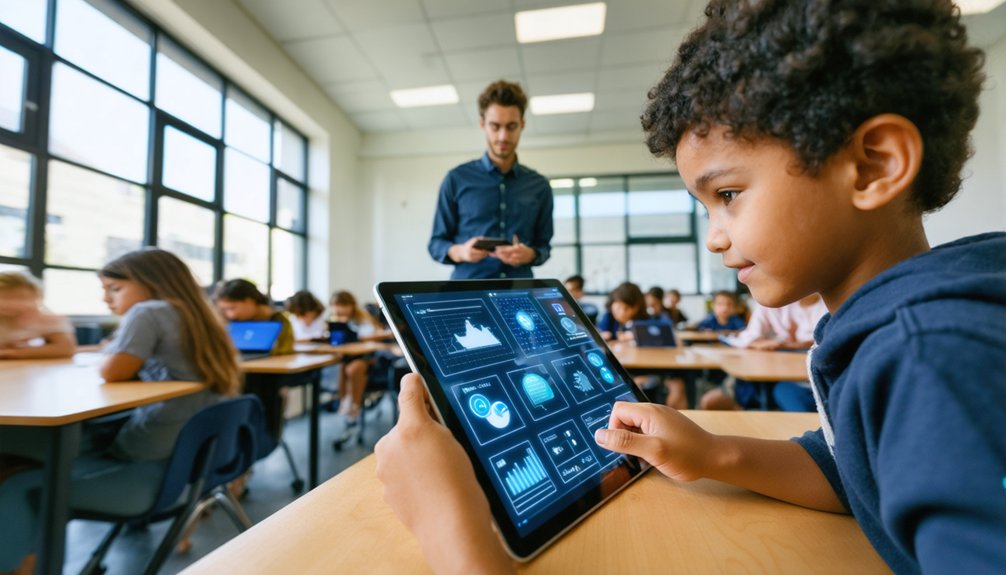

Adaptive learning tools deliver individualized instruction and real‑time feedback, letting systems detect gaps and adjust difficulty per student. They combine frequent low‑stakes assessment, predictive analytics, and multimodal resources to boost engagement, attendance, and mastery. Teachers offload routine grading and scheduling, focusing on targeted interventions guided by shared mastery dashboards. Scalable platforms lower per‑student costs while raising privacy and equity concerns that demand governance and professional development. Continued exploration explains implementation steps and safeguards.
Key Takeaways
- Adaptive tools personalize pacing and content using performance and affective signals to create individual learning pathways.
- Frequent low-stakes assessments and adaptive difficulty reveal gaps early and improve mastery outcomes up to ~30%.
- Real-time dashboards and predictive analytics flag students needing support, guiding targeted interventions and high-dosage tutoring.
- Interactive, multimodal features and collaborative platforms boost engagement, accessibility, and inclusive participation when well-integrated.
- Automation of grading, scheduling, and analytics reduces teacher workload, enabling more time for instruction and tailored support.
The Rise of AI Adoption in Schools
How rapidly is artificial intelligence reshaping classrooms worldwide? Data shows swift, measurable adoption: 86% of education organizations now use generative AI, the AI-in-education market reached $7.57 billion in 2025, and investment has expanded more than 2.5x since 2019.
Institutions deploy tools for lesson planning, feedback, and administrative efficiency while regions like Asia-Pacific grow fastest. Educators and students report routine use, with many verifying outputs and seeking guidance.
Two-thirds of higher education institutions are developing policy frameworks to govern use, and schools increasingly allocate budgets for AI initiatives. To sustain responsible integration, leaders pair technology with professional development, ensuring communities feel included, competent, and aligned with institutional goals. Governments and accrediting bodies are also beginning to issue guidance that shapes implementation, with growing funding supporting pilot programs. Research shows personalized AI learning can improve student outcomes by up to 30%. Teachers saving time report redeploying those hours to personalized feedback and curriculum design.
Personalized Learning at Scale
Following widespread AI adoption for lesson planning and administration, attention is turning to how these technologies can deliver personalized learning at scale. Systems combine adaptive content delivery, intelligent gap detection, and predictive analytics to create tailored learner pathways that adjust pacing and difficulty in real time. Pilot programs and large-scale studies show measurable outcome gains—up to 30% improvement—when continuous assessment and immediate feedback are integrated. Competency dashboards surface mastery levels for students and educators, enabling targeted interventions and transparent progress tracking. Implementation requires phased pilots, teacher preparation, interoperability standards like xAPI, and safeguards for privacy and bias. When equitably deployed, scaled personalization fosters inclusive classroom communities while preserving teacher judgment and collective responsibility. Recent research from the Personalized Learning Initiative also highlights the effectiveness of high dosage tutoring as a scalable strategy to accelerate student learning. Schools must also address funding and professional development to sustain long-term adoption of these systems, particularly to support teacher training. Leaders must also provide clarity and encouragement so educators can experiment with AI tools and develop skills to use them effectively, especially through leadership guidance.
Boosting Student Engagement With Interactive Tech
A growing body of evidence shows that interactive technologies can substantially reverse alarming engagement trends by making learning more focused, collaborative, and multimodal.
Research links screen-sharing, interactive whiteboards, and LMS use to improved focus, deeper thinking, and reduced distraction when pedagogically integrated. Collaborative platforms and peer tutoring increase active participation, making projects more relevant and enabling shared responsibility. High-engagement students are more likely to thrive and feel optimistic about the future, underscoring the impact of sustained classroom participation on outcomes.
Multimodal tools — simulations, AR/VR, and digital games — accommodate visual, auditory, and kinesthetic learners and permit safe, repeatable practice. Haptic devices providing tactile feedback reinforce kinesthetic learning and concept retention. Automated feedback systems also speed instructor insight into student needs. Recent controlled studies following the DES model show measurable gains in engagement when communication and cooperation are emphasized DES evidence.
Measured studies report higher observable engagement, better attendance, and fewer behavioral incidents where digital engagement strategies are implemented. Implementation requires intentional design and community alignment to make certain technology strengthens connections rather than distracts.
Supporting Teachers With Administrative Automation
Streamlining administrative workflows with automation allows teachers to reclaim hours otherwise spent on grading, scheduling, and paperwork.
Educational institutions deploy automated grading systems that process handwritten, typed, and diagram-based work, delivering consistent, accurate scores and reducing human error across large cohorts.
Attendance automation via facial recognition or biometric methods keeps reliable records while liberating staff from roll calls.
AI also manages scheduling, resource booking, and routine paperwork, cutting manual labor and conflict-prone calendar tasks.
Real-time analytics and dashboards synthesize assessment and operational data so educators can prioritize instruction and targeted support.
Adoption rates—nearly half of primary teachers using AI for assessments and over half using AI for administration—underscore practical benefits.
These tools position teachers to focus on pedagogy and community building.
Adaptive systems further enable personalized pacing by analyzing learner interactions and performance to tailor content delivery, supporting dynamic learner profiles.
Improving Accessibility and Inclusion
How can classrooms become genuinely inclusive for students with diverse needs when access to appropriate tools remains uneven?
Evidence shows most teachers see accessible technology as essential: 84% say equity is impossible without it, 87% note it levels the playing field, yet 70% report resource gaps.
AI-powered systems—voice recognition, LLM-driven adaptivity—offer tailored supports but require upfront assistive design and screen-reader, speech-to-text integration.
Meaningful testing with students and active community feedback must guide development to avoid retrofits that exclude learners.
Persistent digital equity shortfalls, funding limits, and connectivity barriers mean partnerships and targeted Title I investments remain vital.
Transparency about limitations and inclusive design priorities can foster belonging and practical progress.
Measuring Student Progress More Precisely
Building on efforts to make classrooms more accessible, measuring student progress more precisely leverages real-time data and analytics to tailor instruction and verify learning outcomes. Adaptive platforms use real time diagnostics to track accuracy, response time, engagement, retention and hint usage, producing immediate, actionable feedback.
Machine learning models synthesize multidimensional inputs—performance, pacing, affective signals—to update dynamic learner profiles. Frequent low-stakes assessments and adaptive difficulty reveal mastery and gaps early, while predictive analytics flag learners needing support.
Mastery dashboards present concise, shared views of competence across standards, promoting collective responsibility among educators and learners. Transparent metrics and calibrated scoring models foster trust, guide interventions, and enable instructors to align instruction with demonstrated needs, strengthening belonging through informed, equitable support.
Cost Efficiency and Scalability of Adaptive Systems
Many institutions find that adaptive learning systems deliver measurable cost efficiencies and scalable reach by combining automated personalization with discipline-agnostic design and crowdsourced content models.
Observers note that engaging students in creation, moderation, and evaluation lowers development expenditures while promoting higher-order learning and peer quality control.
Discipline agnostic scalability eliminates duplicate investments across subjects, letting platforms serve larger populations without linear cost increases.
Data-driven adaptation concentrates educator time where it matters, reducing redundant instruction and overall training hours.
Market growth and documented learning gains further validate return on investment, encouraging institutional adoption.
Together, these factors produce a transparent, community-oriented efficiency case: adaptive systems can expand access and impact while aligning fiscal stewardship with shared pedagogical purpose through crowdsourced content and scalable architectures.
Challenges and Ethical Considerations
While adaptive learning tools promise personalized instruction at scale, they also introduce a complex set of challenges and ethical questions that educators and institutions must address.
Stakeholders confront data reliability and privacy concerns as systems collect extensive performance and engagement metrics; robust data governance and ethical transparency are required to secure storage, clarify ownership, and limit misuse.
Gaps in teacher training and implementation support impede interpretation of AI-generated analytics, undermining instructional decisions.
Equity issues persist when access, cultural responsiveness, or algorithmic bias disadvantage minoritized learners.
The balance between human judgment and automated recommendations raises questions of responsibility for pedagogy and assessment validity.
Effective adoption demands clear policies, ongoing professional development, rigorous evaluation frameworks, and community-centered governance to foster trust and inclusion.
References
- https://www.open2study.com/statistics/ai-in-education/
- https://www.aiprm.com/ai-in-education-statistics/
- https://www.digitallearninginstitute.com/blog/education-technology-trends-to-watch-in-2025
- https://www.ed.gov/sites/ed/files/documents/ai-report/ai-report.pdf
- https://www.scrumlaunch.com/blog/ai-in-education-transforming-learning-and-teaching-in-2025
- https://www.weforum.org/stories/2025/01/how-ai-and-human-teachers-can-collaborate-to-transform-education/
- https://elearningindustry.com/ai-powered-adaptive-learning-ushering-in-a-new-era-of-education-in-2025
- https://www.cengagegroup.com/news/perspectives/2025/ais-impact-on-education-in-2025/
- https://www.enrollify.org/blog/ai-in-education-statistics
- https://www.engageli.com/blog/ai-in-education-statistics